
GENERAL DENTISTRY
“WE PROVIDE PAINLESS DENTISTRY”
Get in touch with us today!
It encompasses both white as well as pink aesthetics. Thus it is essential that there is harmony between the teeth and the surrounding gums. This speciality dentist leaves no stone unturned to give a beautiful and healthy smile to the people. They are..
A) Oral Prophylaxis
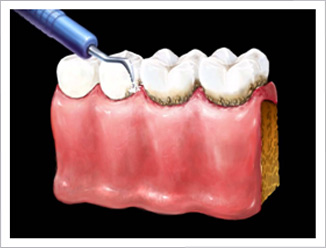
This process is performed by a trained dentist. They use ultrasonic instruments called scalers to remove plaque from unreachable areas above and below the tooth into the sulcus. Scaling is performed by vibrations which loosen the plaque and calculus and remove it. As the vibrations are very delicate, they do not harm the tooth surface. Once the procedure is performed polishing of the teeth is done where an abrasive paste is used to clean small irregularities and stains from the teeth. Generally it takes 30-40 minutes to finish the procedure. Our team is highly skilled in performing this most important procedure in the field of dentistry to keep your mouth disease free at any point of time.
B) Simple tooth Extractions
The process of removing the tooth from its socket is called tooth extraction. The panel of dentists in our clinic first try to retain the tooth. When all possible ways fail after that only the tooth is extracted.
Extraction is carried out for teeth beyond repair i.e. in which root canal treatment cannot be performed, which is badly positioned, extensively broken or very mobile. Other ideal candidates for removal are orthodontic treatment patients in whom removal is deemed necessary.
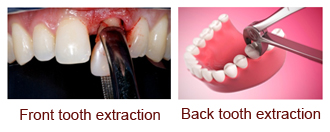
Most people have phobia regarding tooth removal. At V4U Dental Care we provide a very comfortable environment and follow a stress free protocol for extraction. It is carried out for teeth that are visible in the oral cavity only. Firstly a local anaesthetic solution is injected in the area where the tooth is to be removed. After the surrounding area gets numb, the gums are detached from the tooth by a hand instrument called gum separator/periosteal elevator. After the gums are separated the tooth is loosened a little from its socket by the use of tooth elevators using rhythmic wriggling movements. Once the tooth is loose in its socket, it is removed with the help of tooth forceps. After the tooth is removed, the area is irrigated with saline and scrapped with a spoon excavator to remove all diseased tissue. After this, slight pressure is applied to stop the bleeding with the help of cotton/gauze piece. A small piece of cotton is placed at the site and the patient is asked to bite on it for half an hour.
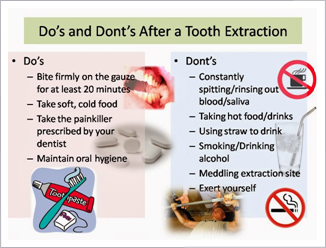 After the completion of the procedure the patient is told to wait for approx. 15 minutes and later checked whether bleeding has stopped. The patient is instructed to remove the piece of cotton after about half an hour. Incase of infections antibiotics and painkillers are prescribed for 5 days. Patient is informed that the effect of anaesthesia will last for atleast 1 hour and till then do not drink or eat hot food as you can burn yourself. Do not bite the tongue, lips or cheeks. They are advised to refrain from eating spicy, hard or oily foods for 2-3 days and should eat on the other side of the mouth and not from the side tooth is removed. The patient is told to swallow all blood, saliva on the day of the procedure and not to spit. Incase of liquid consumption they should not use a straw but drink directly from the glass/bottle. They should refrain from smoking for a day atleast as all procedures that create negative pressure stimulate more bleeding. All these instructions HAVE to be FOLLOWED by the patient for fast and uneventful healing.
C) Silver Fillings/ Amalgam Fillings
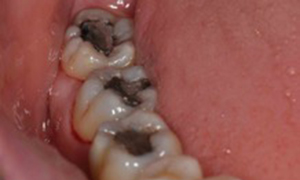
Once a tooth is decayed, it has to be immediately restored back to its normal contour by removing the caries and filling it with inert materials. These dental fillings take the place of the lost tooth structure in the oral cavity. They are used on either one surface or all surfaces of the tooth. Dental amalgam fillings are the oldest in the field of dentistry.
D) Dental Inlays and Onlays:
When the extension of caries is present on more than one surface but not the whole tooth then chances of restorations like silver amalgam or composite to fracture are high. In such cases inlays or onlays can be preferred to full crowns. These fillings are fabricated in a dental lab and then are cemented on the tooth with the help of cements. They have more strength and are resistant to fracture.
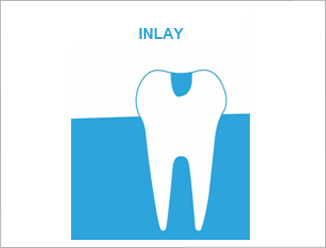
When the restoration is present within the confines of the tooth it is called an inlay. Here only the chewing surface is involved.
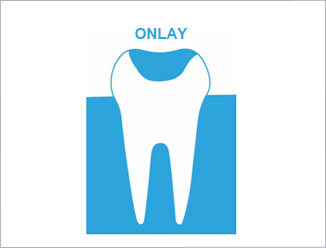
When the restoration covers more than one surface involving a cusp then it is called an onlay.
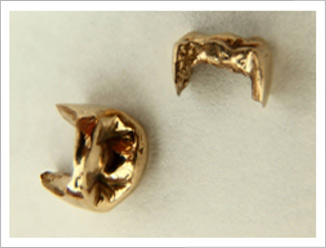
Metal inlay/onlay
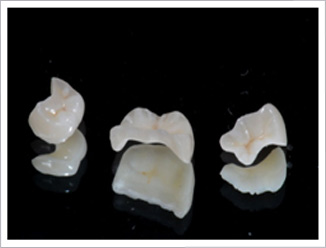
Ceramic inlay/onlay
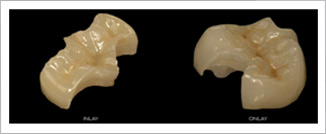
Zirconia inlay/onlay
E) Dental crowns:
Crowns are fondly known as caps by patients.
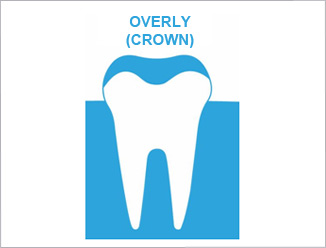
When the tooth is beyond repair or it is cracked due to trauma, extensive caries, only then a crown is placed on the tooth. Its purpose is to encompass the weakened tooth, give it strength and resume its function. It can be made of various materials like metal, porcelain fused to metal, full ceramic or zirconia.
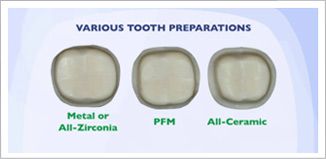
When a crown is deemed necessary the patient will be informed about it and the various materials are explained to the patient.
On the next appointment the procedure is started by giving a local anaesthesia to numb the tooth so that there is no sensitivity during crown preparation. The tooth is reduced all over by removing the outer layer according to the size of the crown to be placed on it. Thereafter a final impression of the prepared tooth is taken and a mould is prepared which is sent to the laboratory for the fabrication of the crown. Until then the temporary crown is placed on the tooth to prevent it from fracture and sensitivity. Proper oral hygiene procedures are explained to the patient for the care of the crown. The next appointment is scheduled after 3-4 days once the final crown is sent by the lab.
On the third appointment the temporary crown is removed and the permanent crown is placed on the tooth which is of the same colour of the surrounding teeth incase when tooth coloured materials are used. Final finishing is done and the patient is asked to check if there are any premature contacts of the other teeth due to the crown. Once the patient is satisfied oral hygiene instructions are again reinforced to the patient. The permanent crown is cemented to the tooth and the proud and confident patient is ready to face the world with his new found smile that was restored because of the crown fabricated by our skilled professionals.
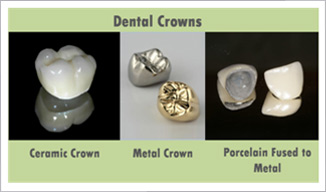
Earlier crowns were made of gold, followed by metal. But both of them were not tooth coloured so now their use is very limited. With advanced technology now crowns are available in tooth coloured materials like composite, porcelain fused to metal where ceramic coating is given to metal crown to hide its silver colour. This crown has excellent strength of metal and amazing colour matching due to ceramic. Other materials used are full ceramic or zirconia crowns which are mostly placed in front teeth as the given excellent colour matching to adjacent teeth. Thus, they give an illusion of a natural tooth.